
The Consultation
Neurology Consultation
The first time you as a patient come to see me, you will spend about 45 minutes in the consulting room during which I will take a detailed history of the main symptoms and of the relevant past medical history and then perform a neurological examination and if relevant, also undertake other medical examination. I will then explain what I think is the cause of the symptoms and what further tests or treatment are required. My emphasis is on a detailed and thorough history and examination. I have a reputation for empathy, approachability, good humour and being able to reassure where there are concerns and anxieties. I will usually arrange at least one follow appointment with me in order to go through test results and or assess your response to treatment.
Sleep Medicine Consultation
This is very much along the same lines, but with an emphasis on sleep-related symptoms and with usually less in the way of examination. I will usually arrange at least one follow-up consultation to review you with the results of home pulse oximetry, in-patient full PSG Sleep Study, Multiple Sleep Latency Test or Actigraphy. Decisions upon treatment will usually be made at this stage.
Remote Video Consultation
Remote consultations are generally not suitable for new patient neurology consultations, but are quite suitable for sleep medicine consultations. See SussexSleep website: Sussex Sleep. This is because new patient neurological consultations require a physical neurological examination in order to provide a full assessment.
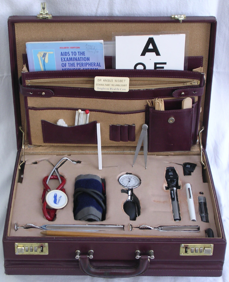
My Neurological Examination Kit
There are various instruments for measuring different types of skin and deep sensation, vision, smell, tendon reflexes, pupil reactions and for looking at the optic nerve head, retina and retinal blood vessels.
Neurological Tests
I have access to specialist neurological investigations at Hurstwood Park Neurological Centre such as EEG, Nerve Conduction Studies, Evoked Potentials, Carotid Dopplers, lumbar puncture and neuro-immunological tests on blood and cerebrospinal fluid. I also have access to all the MRI scanning units in Sussex and to other investigations at local private and NHS hospitals.
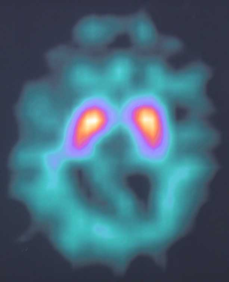
DAT Scan
This is one slice from a dopamine scan of the brain where an intravenously-administered radioactive tracer is taken up by the dopamine terminals in the brain and detected using a gamma camera scanner. It produces lovely pictures but in practice is rarely helpful in diagnosis! This picture is actually from the first DAT scan we ever did in Brighton in 2002.
MRI Scan
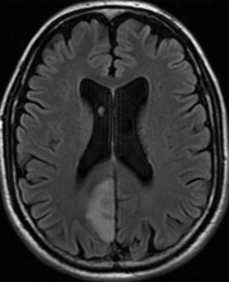
This is one slice of a so called FLAIR MRI sequence. It shows an area of high signal in the occipital lobe of the brain corresponding to an area of encephalitis
EEG
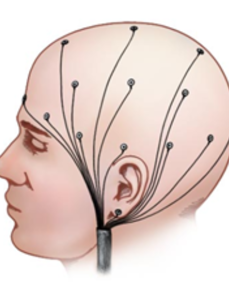
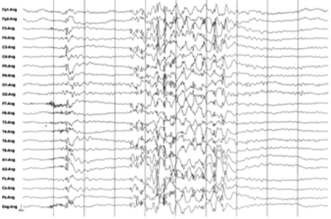
This is a diagram of how an EEG (electro-encephalogram) recording is made. Below to it is an EEG recording of a spike & wave epileptic discharge
Sleep Tests
Home Oximetry
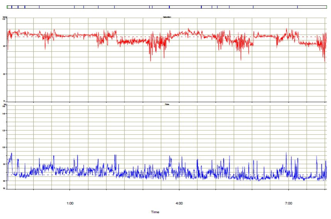
This involves lending you a small device which shines red light through a finger to measure and record blood oxygen levels during the night.
Full Polysmonogram (PSG) Sleep study
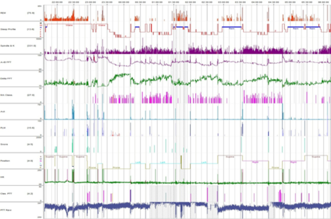
This involves admitting you overnight for a where a lot more data can be can be recorded, including EEG, ECG, breathing, muscle activity and video-recording . This is a typical summary graph obtained from one of my patients during an overnight PSG Sleep study at the Sleep Disorder Centre, East Grinstead.
Multiple Sleep Latency Test (MSLT)
This is a test to help confirm a diagnosis of narcolepsy and other conditions causing sleepiness. It involves spending a day on the sleep unit or in the Neurological Centre during which your ability to fall asleep is measured during 4 or 5 deliberate naps over the course of a day.
Actigraphy
This is to chart sleep cycle disturbances. It involves wearing a special type of watch-like device, which measures activity and is worn on the wrist for 2 to 3 weeks.